
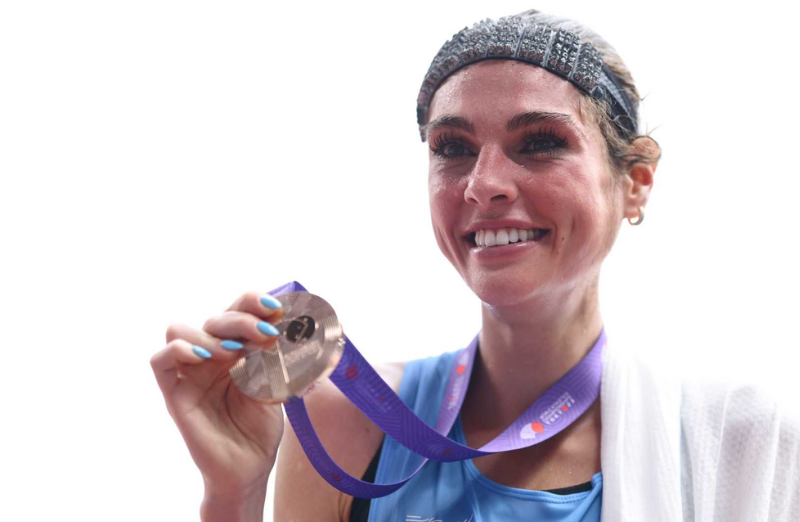
“Julia Paternain celebrates Uruguay’s first-ever World Championship marathon medal, even without her flag in Tokyo.” (Getty Images)
By Sayer Zaland
MONTEVIDEO: The moment Julia Paternain crossed the finish line at the National Stadium in Tokyo, the world of athletics gained a new name, a new story, and perhaps, a new legend. But as she stood on the podium with a bronze medal around her neck, one detail stood out: there was no Uruguayan flag draped over her shoulders.
The organizers had been caught off guard. They had flags for the Kenyan and Ethiopian stars, Peres Jepchirchir, the Tokyo 2020 Olympic champion who took gold, and Tigst Assefa, the Paris 2024 runner-up who claimed silver. But for the young woman ranked 288th in the world? For the underdog who had shocked the marathon world?
So Julia celebrated with a towel instead. And yet, the absence of the flag could not dim the magnitude of what had just happened: the first-ever World Championship marathon medal for a Latin American woman.
“I Was Just Trying to Finish.”
26 years old, Julia Paternain had no illusions when she lined up against the world’s best. This was only her second-ever marathon.
Her goals? Modest.
1. Finish the race.
2. Maybe sneak into the top 30.
3. A dream scenario: a top-eight finish.
A medal? “Not even on the radar,” she told reporters, laughing.
And yet, as the kilometers went by, as the heat and humidity of Tokyo drained the favorites one by one, Julia stayed in the pack. Then, suddenly, she was in third place.
“I was terrified that it wasn’t the finish line,” she joked afterward. “I thought I still had another 400 meters to go. I couldn’t believe it until one of the officials told me it was over.”
Her bronze medal marked a breakthrough not just for her, but for Uruguay—a small country where football usually dominates headlines and where marathon running rarely finds the spotlight.
Julia’s story is as complex as it is compelling. Born in Mexico to Uruguayan parents, raised in England since age two, and now living in Arkansas, USA, she holds three passports and has competed for Great Britain at the U-23 European Championships.
But when it came to the biggest moment of her career, she chose Uruguay.
“My blood is Uruguayan,” she said firmly in the mixed zone. “Almost all my family lives there. I grew up spending vacations in Montevideo, running along Playa Ramírez. It just felt right to run for Uruguay.”
Her parents, both academics, her father, Gabriel, a PhD in Mathematics, her mother, Graciela, a Statistician, instilled in her a love of education and discipline. But it was her mother’s words before the race that echoed most loudly: “Focus on the finish line. Remember what Obdulio Varela told the Uruguayan footballers before Maracanazo: those outside are made of wood.”
It was a call to shut out the noise, the pressure, the weight of history.
Julia’s marathon career began only last March, when she broke the Uruguayan national record in her debut with a time of 2:27:09, qualifying her for Tokyo.
“She’s a runner who embodies what modern athletics is about,” said Diego Rodríguez, a South American athletics analyst. “Global roots, academic discipline, and a sense of national pride that transcends where you live. Her medal will inspire a whole generation in Uruguay.”
And yet, she laughs at herself, too. “I don’t even like mate,” she admitted, referring to the herbal drink Uruguayans hold sacred. “But other than that, I’m 100% Uruguayan.”
As she stood on the podium with Jepchirchir and Assefa, both wrapped in the colors of Kenya and Ethiopia, Julia had only her medal and her smile.
It brought back memories of another moment in Uruguayan sports history: the 1950 World Cup final, when FIFA president Jules Rimet famously failed to bring the trophy onto the field after Uruguay’s shocking win over Brazil.
“Come on,” Obdulio Varela, the legendary captain, said that day. “With or without the Cup, we are the world champions.”
Julia Paternain must have felt the same. With or without the flag, she had made history.
For Uruguay, this was more than a medal. It was a reminder that in sport, as in life, the unexpected can happen when preparation meets courage.
Julia’s bronze was not just a personal triumph, it was a moment of national pride, a story of identity and perseverance.
And somewhere in Montevideo, along the promenade of Parque Rodó, future runners will lace up their shoes, dreaming not just of finishing a marathon, but of following in the footsteps of the girl who once crossed the finish line in Tokyo without a flag, and with the whole world watching.
