
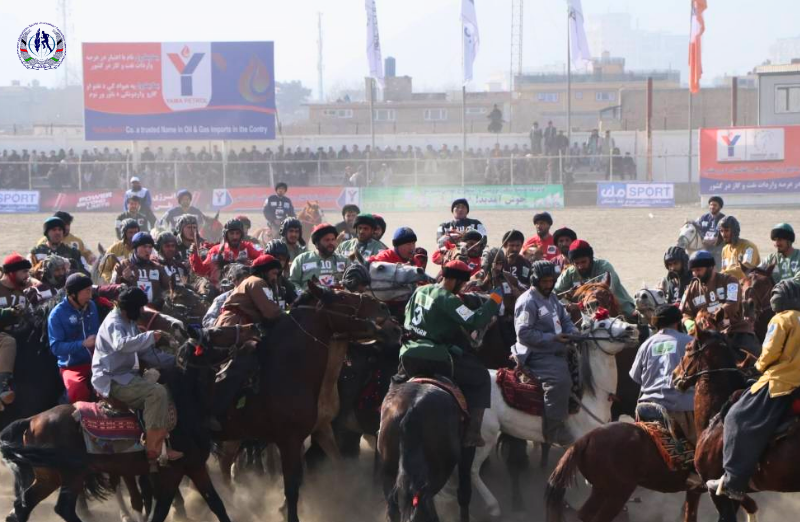
Afghanistan’s seventh Buzkashi League opened in Kabul with 11 provincial teams and foreign riders, as senior officials used the event to project political authority, cultural continuity, and a unified national identity through the country’s most symbolic traditional sport.
Kabul | Sara Amiri
The seventh edition of Afghanistan’s Buzkashi League was inaugurated in Kabul in a ceremony that underscored how the traditional sport has become a stage for political signaling and cultural identity-building. Senior representatives from the national sports authority, Kabul’s provincial government, state media leadership, and the Buzkashi Federation attended the event, reinforcing the league’s new role as both a sporting competition and a platform for state visibility.
Sports Authority Director General Mawlawi Ahmadullah Wasiq told attendees that this year’s league would be “different from previous editions,” an indication of the administration’s growing emphasis on traditional sports as instruments for national cohesion. Federation President Haji Sarwar Jalal welcomed the 11 participating teams and highlighted the contributions of private sponsors, whose support aligns increasingly with broader cultural initiatives.
Kabul Governor Mullah Aminullah Ubaid argued that traditional sports must expand further, framing Buzkashi as a core element of Afghanistan’s heritage. Officials from Yama Petroleum, the league’s title sponsor, echoed similar themes, promising long-term backing for the sport and its riders.
The 2025–26 league includes teams from Kunduz, Faryab, Balkh, Badakhshan, Takhar, Bamyan, Sar-i-Pul, Panjshir, Samangan, Baghlan, and Herat, alongside several foreign riders brought in to elevate the competition. The opening match between Kunduz and Balkh is scheduled for Friday.
Buzkashi has long served as a marker of regional influence, social standing, and communal identity across northern Afghanistan. In recent years, the sport has gained renewed political importance as authorities promote traditional games to reinforce cultural authenticity and project unity. Earlier editions of the league have seen increased official attendance, expanded media coverage, and a deliberate effort to present Buzkashi as a symbol of national identity.
This transformation reflects a broader shift in how traditional sports are used: not only as athletic contests, but as tools for cultural consolidation and public legitimacy.