
FIFA has released the official procedures for the Final Draw of the 2026 World Cup, set to take place on 5 December at the Kennedy Center with teams learning their group-stage pathways.
Washington DC | By Sayer Zaland
FIFA has confirmed the procedures for the Final Draw of the FIFA World Cup 2026, outlining how the 48 participating teams will be allocated into 12 groups during the ceremony scheduled for 5 December at the John F. Kennedy Center for the Performing Arts.
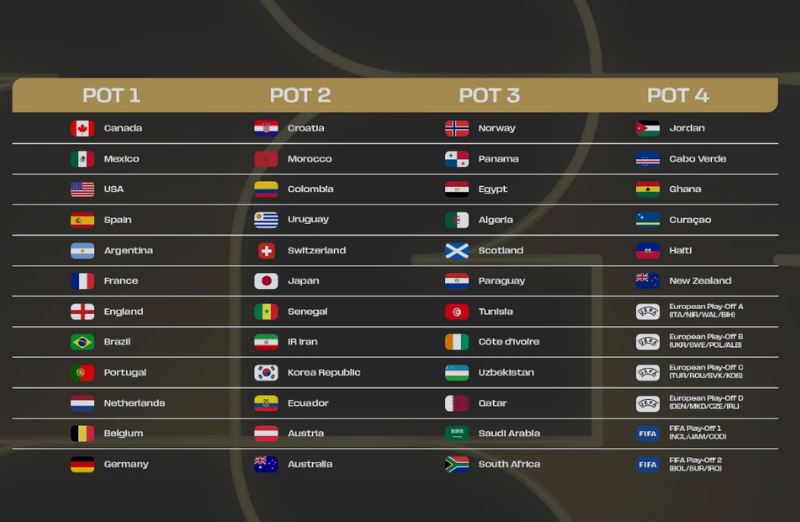
The draw, regarded as a major milestone ahead of the expanded World Cup, will assign teams to groups A to L based on the FIFA/Coca-Cola Men’s World Ranking of 19 November 2025. Hosts Canada, Mexico, and the USA will be placed in pot 1 and automatically allocated to positions A1, B1 and D1 using colour-coded balls. The remaining nine top-seeded teams will fill the remaining group leader positions.
Pots 2, ,3 and 4 will be organised according to global rankings and continental pathways. The two FIFA play-off winners and four European play-off placeholders will be assigned to pot 4. Confederation constraints will apply, ensuring no group contains more than one team from the same confederation, except UEFA, which may have up to two representatives per group.
FIFA has also established competitive safeguards for the knockout pathways. The four highest-ranked teams — Spain, Argentina, France and England — will be drawn into opposite halves of the bracket to prevent early clashes, ensuring they cannot meet before the final should they top their groups.
The allocation of group positions will follow a predefined pattern set out in the official procedures, and the full match schedule, including stadium assignments and kick-off times will be released on 6 December.
The 2026 World Cup will be the first tournament featuring 48 teams, co-hosted across Canada, Mexico and the United States. The expanded format includes 12 groups of four teams and an extended knockout phase. FIFA’s draw procedures are designed to maintain continental balance, competitive fairness and logistical efficiency across a multi-nation event with complex travel and scheduling requirements.