
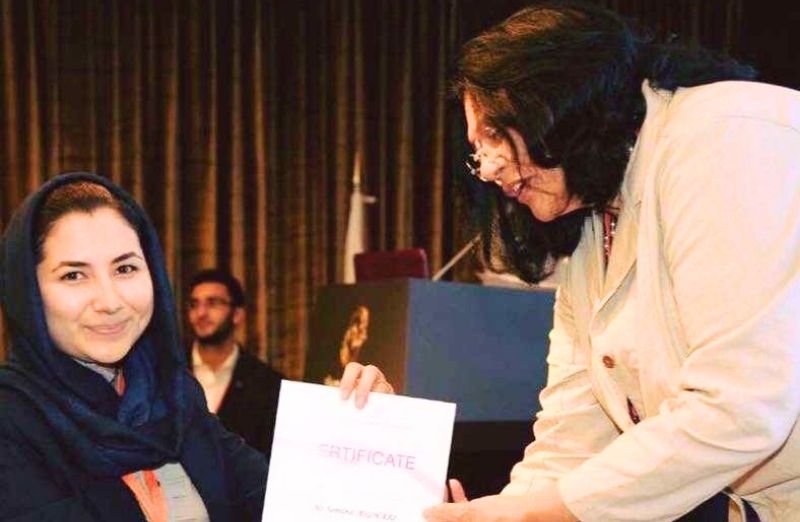
KABUL, July 30, 2018 – It was 24 years ago, when Afghanistanwas captured by the Taliban, when there was no safety and place for sports inthe country, that a family brought a daughter into the world. It was also atime when the nation’s culture was very much against daughters, This family, however,was happy for the new blessing, and for a girl.
Just after her birth, the Asghari family was forced to flee to Iran. Away from their homelandand beloved Afghanistan and at the time, the family didn’t believe that they wouldever be able to return to their house in Kabul. The named the child Samira and promisedto inspire her to learn and study and to do sports wherever they could.
Refugees Her fatherhad practiced martial arts and kung fu for years, while her uncle and twinbrothers used to do gymnastics. Samira followed her father’s footsteps intokung fu first, before finding her own way in basketball. The family livedtogether as a middle class refugee family, but always was courage to bringpride to the nation and to her her family.
“As we were refugees we weren’t very rich, but with allpassion and enthusiasm my family and I had we tried our best, to do our best,” SamiraAsghari said.
Doing their very best led to this girl to become active inpromoting the right to play sports for women in her own war-torn country, andnow, is nominated to become an IOC member.
RepresentingAfghanistan Samira Asghari is a passionate girl, from a well-known Afghansports family, and with a warm and welcoming heart. When she speaks to you, shelooks very calm and confident, with an intelligent and innocent face. She playedbasketball for the Afghanistan national team and has taken on a series ofadministrative roles with the Afghanistan Olympic Committee.
At 24, Samira Asghari now hopes to become youngest IOCmember in the last hundred years of IOC history.
According to Samira, from the very beginning when she learnedabout sports and national pride from her family, she was very much convinced tobecome an icon and represent the nation.
She comes from one of Afghanistan’s most dangerous provinces- Maidan Wardak, in the Jalrez district, where insurgents have captured many districtsthat continue to be under their control even today. Samira cannot go to visither relatives and the people she loves, nor can she reach out to so many ofthose girls who are still not aware about education and sports.
“My parents came to the Iran, when I was barely a few monthsold. But while I did not had any memories of Afghanistan, my parents andgrandparents have always shared their wonderfully vivid memories and it isbecause of this that I love my country and people,” she told AIPS Media.
Sporting path SamiraAsghari grew up practicing kung fu, like her father, but eight years ago whenshe was in her 9th year, in high school, she became interested in basketballand started to learn to play the game.
Samira told AIPS Media that from the moment she started hercareer as an athlete, her family fully supported her. She is one of the fewAfghan girls who have their family’s support to do sports.
“When I started to be an athlete, there were so manycultural challenges, people from my province were talking and they wanted toprevent me from doing sport, but my family supported me and told me to do myjob,” Samira said
According to Samira, with her family’s support and herconfidence and skill, she became a member of the Afghanistan national basketballteam, first at a junior level and then for the senior women’s team, and hassince then felt a responsibility for sport in the nation.
“We often didn’t had enough resources, but thanks to the NOCand Afghanistan Basketball National Federation, we were allowed to take part ina few tournaments, and we did our best to bring pride to the nation,” shesmiled.
A role model ManizhaAmini a female sports journalist who has covered basketball for many years, explainedthat that Samira was a role model for other girls from the very beginning.
“She is a hardworking girls, and whenshe played for Afghanistan, she brought that motivation to the other playersand the whole team,” Manizha said.
Reaching the dream Formerpresident of Afghanistan National Olympic Committee Gen. Zahir Aghbar was oneof those who was confident in Samira’s talent on and off the court, which iswhy he brought her to the Afghanistan National Olympic committee, where shestarted to work as female representative and then as an International Relationboard member of the NOC.
According to Samira, with Aghbar’s confidence and her hard work,very soon she became known within national and international sport, after whichshe shifted to start a new mission as a member of the Culture Committee of OlympicCouncil of Asia. “As my dream was nearing, my aim was to serve my people andthose who need support, I worked day and night and after everything, in 2014 Ibecome member of IOC Athletes’ Entourage Commission,” she said.
At the same time, she was working with the Afghanistan NationalOlympic Committee as a Financial Director for one year and then as Deputy SecretaryGeneral until 2017 and with her membership in the Athletes’ EntourageCommission, she is very happy and hopeful to become an IOC member and representAfghanistan and female youth in the IOC.
“I am very excited, women everywhere and especially women inthose countries who are suffering from war, insecurity, cultural and many otherproblems, need support and we should join hands with them.”
Women in sport Samiraexpressed her thanks to the IOC for its crucial initiative of bringing in womenand representing women, talking and working for women and for those who needthe IOC support. “It will be a source of great pride for me, for my nation andespecially for all women around the world to raise their voice in IOC,” she said.
Samira thinks the time is right time for her to be candidate for this positionin the IOC, to work directly together with her NOC and the IOC in a bid tofocus on young athletes in Afghanistan, and around the world who are sufferingfrom the consequences of poverty and war.
“Becoming an IOC member would mean bringing positive change,and giving hope, for better opportunities and conditions for practicing sportin the world,” Samira said.