
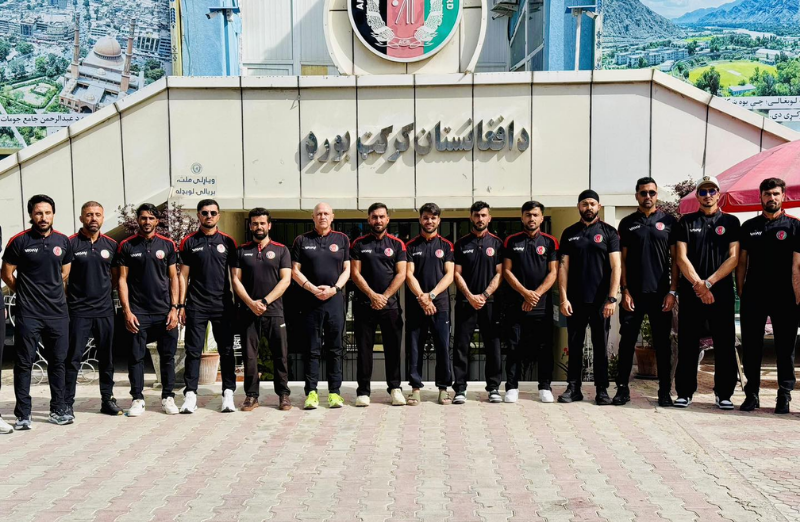
The Afghanistan Cricket National team squad headed to India ahead of a one-off Test and three-match ODI series, carrying a squad that blends established international figures with emerging talent, as the team seeks to test its progress against one of cricket’s most demanding opponents.
Kabul | By Sara Amiri
Afghanistan’s national cricket team has arrived in India ahead of a tightly scheduled tour comprising a single Test match followed by a three-match ODI series, a journey that arrives at a moment when the side’s development is increasingly measured not by promise, but by performance against elite opposition.
The tour, beginning with a Test on June 6 and continuing with ODIs from June 13 to June 20, represents another significant step in Afghanistan’s gradual transition from an emerging cricketing nation into a consistently competitive international side. Yet the challenge now is less about participation and more about sustaining competitiveness across formats against a full-strength Indian team playing in familiar conditions.
A Squad Built on Continuity and Strategic Balance
Afghanistan’s selection reflects a deliberate emphasis on stability, particularly in leadership and core roles. Hashmatullah Shahidi remains central to that structure, continuing as captain across both formats and anchoring a batting unit that will be heavily tested in the longer format.
The Test squad retains a traditional structure with a focus on patience and accumulation. Players such as Rahmat Shah, Abdul Malik, and Sediqullah Atal will be expected to absorb pressure in conditions that historically expose technical vulnerabilities in visiting batting line-ups. The inclusion of dual wicketkeeping options in Rahmanullah Gurbaz and Ikram Alikhil signals tactical flexibility, though it also reflects the ongoing search for consistency behind the stumps in Test cricket.
The bowling unit presents a more varied profile, combining spin depth with pace options that remain in development. While Afghanistan’s identity in white-ball cricket has been strongly shaped by spin, the Test environment will again test whether that strength can be translated into sustained control over long passages of play. Rashid Khan, Mujib Ul Rahman, AM Ghazinfar, and Afghanistan’s top batter, Ibrahim Zadran, are missing the Test match against India.
ODI Squad Anchored by Established Match-Winners
The ODI squad presents a more settled and experienced core, led by familiar names who have already shaped Afghanistan’s competitive identity in limited-overs cricket. Rashid Khan and Mohammad Nabi remain central figures, not only for their skill but for the structural balance they provide across innings phases.
The top order, featuring Rahmanullah Gurbaz, Ibrahim Zadran, and Sediqullah Atal, will carry much of the batting responsibility against an Indian attack known for early breakthroughs and sustained pressure in home conditions. Azmatullah Omarzai continues to emerge as a key all-round option, reflecting Afghanistan’s gradual shift toward multi-dimensional players capable of bridging batting and bowling demands.
The presence of emerging talents alongside established performers highlights a broader strategic tension: Afghanistan is no longer building a team for exposure, but attempting to consolidate a competitive core capable of competing consistently in high-intensity series.
A Series Defined by Structural Contrast
The tour arrives within a broader cricketing imbalance that has long defined bilateral contests between established and developing Test nations. India, with its deep domestic structure and extensive international experience at home, represents a benchmark that exposes gaps in technique, depth, and adaptability.
For Afghanistan, the significance of this series extends beyond results. The Test match will serve as a measure of technical maturity in red-ball cricket, while the ODI series will test the sustainability of their more established strengths under pressure across multiple games.
What is increasingly evident is that Afghanistan’s cricketing trajectory is no longer assessed in isolation. Each tour now contributes to a longer evaluation of whether the team can transition from sporadic competitiveness to structural consistency across formats.
As the squad settles into Indian conditions, the focus will inevitably shift from selection to execution. In that space, Afghanistan’s evolving cricket identity will be tested not in theory, but in the unforgiving rhythm of international cricket.