
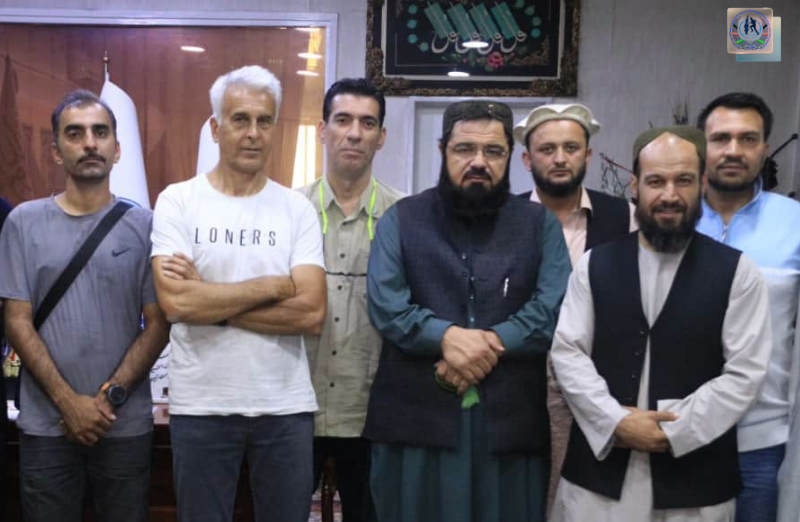
A four-member team of Iranian mountaineering instructors is set to conduct a 10-day training camp in Bamyan for 90 Afghan mountaineers. The programme aims to strengthen technical and professional skills, promote exchanges between instructors from the two countries and support the further development of mountaineering in Afghanistan.
Kabul | By Taieb Khatizwal
Hafiz Ahmad Jan Zadran, deputy for technical and professional affairs at the General Directorate of the National Olympic Committee, Physical Education and Sports, met with a team of mountaineering instructors from Iran and welcomed their presence in Afghanistan to support the training and development of Afghan mountaineers.
During the meeting, Zadran welcomed the Iranian instructors and athletes and expressed hope that their participation would provide opportunities for professional training and the exchange of experience.
The four-member Iranian team is scheduled to conduct a 10-day training camp in Bamyan, providing basic, technical, practical and professional mountaineering instruction to 90 Afghan mountaineers.
The programme will be held in parts of central Bamyan as well as the Shah Foladi and Qala-e Shah Foladi mountainous areas. Participants will receive practical training at elevations of around 4,200 metres, with altitude training reaching up to 5,140 metres.
At the conclusion of the programme, some participants will also have the opportunity to receive coaching development training and qualify for a third-grade coaching certificate.
The training camp is scheduled to begin tomorrow in Bamyan. Organizers said its objectives include improving the technical and professional knowledge and skills of Afghan mountaineers, facilitating experience-sharing between coaches from the two countries and creating opportunities for the further development of mountaineering in Afghanistan.
Mountaineering is practiced across Afghanistan’s mountainous regions, including Bamyan. Training programmes and technical exchanges provide athletes and coaches with opportunities to develop specialized skills and improve safety and professional standards in the sport.