
Who Controls the APL’s Teams?
The Afghanistan Premier League has named its captains and head coaches ahead of its planned return. A restricted selection pool and changes to the recruitment timetable raise questions about how much control franchise owners have over the teams they finance.
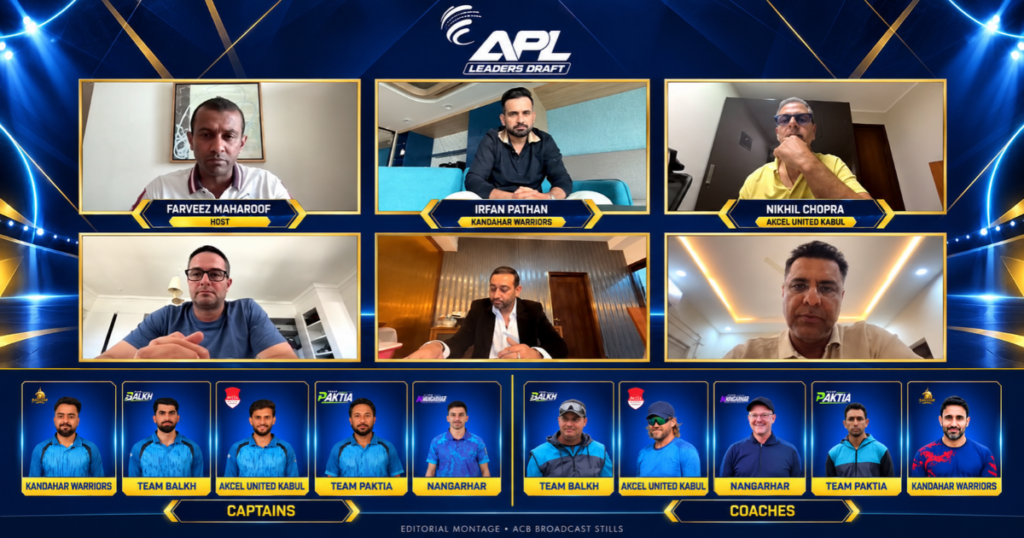 Credit: AI-assisted editorial montage based on ACB broadcast screenshots.
Five franchises needed captains. The shortlist contained five names.
The Afghanistan Cricket Board offered the same number of candidates for the five head-coaching positions. As each franchise made its selection, the options would narrow for those that followed. Unless the rules permitted another arrangement, the last team would have one candidate remaining.
The format provided a way to distribute experienced players and coaches across the Afghanistan Premier League. It also made selection order particularly important—and brought a central question into focus: which decisions belong to franchise owners, and which remain with the league’s organisers?
For a competition attempting to return after its first edition in 2018, that question has consequences beyond the draft. Owners are expected to finance teams, attract sponsors and build support. Their ability to shape the cricket operation is part of that investment.
The APL now has established names attached to all five sides. Explaining how those appointments were made would help show prospective players, sponsors and supporters how the competition will operate.
Five appointments, different priorities
Rashid Khan will captain Kandahar Warriors, while Azmatullah Omarzai will lead Akcel United Kabul. Rahmanullah Gurbaz has been named Nangarhar’s captain, Rahmat Shah Paktia’s and Ibrahim Zadran Balkh’s.
The head coaches are Ravi Bopara at Kandahar, Shane McDermott at Kabul, Toby Radford at Nangarhar, Azhar Mahmood at Paktia and Mickey Arthur at Balkh.
Those appointments bring international experience to the competition. Whether the selection process gave each franchise sufficient freedom is a separate issue.
Teams do not necessarily seek the same qualities in a captain or coach. One may want to build around an established partnership; another may prioritise a particular style of cricket or a coach’s experience developing younger players.
A restricted shortlist can serve legitimate purposes, including distributing leading players and keeping recruitment within an agreed financial framework. But when candidates and vacancies are equal in number, the difference between choosing first and choosing last becomes substantial.
That makes the method of determining selection order important. So are the options available to a franchise that does not want the remaining candidate.
The ACB’s pre-draft statement identified the candidates and described the broad selection arrangements. It did not explain how the order would be decided or whether franchises could decline, exchange or seek approval for an alternative appointment.
A clear account of those rules would allow the process to be assessed without relying on speculation.
Where authority sits
The captain and head coach will influence decisions that follow: the balance of the squad, overseas recruitment, spending priorities and opportunities for Afghan players.
The ACB said the leadership appointments would allow franchises to prepare for the players’ draft in consultation with their captains and coaches. In practice, the first selections will help shape the rest of each team.
Owners therefore need to understand the extent of their authority before recruitment advances. Can they approve the squad strategy? Who settles a disagreement over a signing? What happens if the owner and the appointed cricket staff cannot agree?
A centrally regulated competition can still give franchises meaningful independence. Organisers can establish eligibility requirements, financial safeguards and competition standards, with teams making decisions within those boundaries.
The arrangements need to be explicit. Written procedures protect owners from unexpected restrictions and organisers from disputes over powers they understood to have been agreed.
A calendar that has changed
The players’ draft has moved through several announced dates.
In August, the ACB scheduled it for September 27. A later notice on the league’s website extended player registration until October 5 and listed October 24 as the draft date. The board’s October 23 statement then scheduled the leadership draft for October 24 and the players’ draft for November 3.
Changes to a recruitment timetable do not, by themselves, establish mismanagement. Organisers may need additional time to assess candidates, complete agreements or confirm availability.
They do, however, affect the people making plans around the competition.
Franchises need to organise budgets and recruitment. Players and coaches need to consider other commitments. A revised date is more useful when accompanied by an explanation of what has changed and whether other deadlines are affected.
For a league rebuilding after a long absence, dependable communication is part of establishing confidence.
The businesses behind the teams
The ACB announced completed franchise agreements for Kabul, Balkh and Kandahar in August. At that stage, it said the process of selecting owners for the remaining two teams was continuing.
Earlier this month, chief executive Naseeb Khan defended taking time to secure suitable partners. In comments attributed to him by Cricbuzz and reproduced in subsequent reports, he said the priority was credible, financially capable investors who could support the league over the long term.
That is a reasonable objective. It also makes subsequent ownership updates important.
Players, sponsors and supporters should be able to identify the organisation behind each franchise and the people authorised to act for it. Appointing a captain, coach or prominent representative does not answer those commercial questions.
The responsibility continues beyond recruitment. Teams need to honour contracts, support staff and meet their obligations throughout the competition.
What Afghan coaches should gain
The position of Afghan assistant coaches requires a distinction.
Before the leadership draft, the ACB said it would appoint them separately. The shortlisted candidates were Hamid Hassan, Nawroz Mangal, Raees Khan Ahmadzai, Noor Ali Zadran and Dawlat Khan Ahmadzai. Their absence from the selection exercise does not therefore establish that their appointments were abandoned.
The more useful measure will be their eventual responsibilities.
Working alongside experienced head coaches could give Afghan staff opportunities in recruitment, opposition analysis, training and match preparation. Those benefits depend on practical involvement and clearly defined duties.
A role with real responsibility could strengthen coaching in Afghanistan after the tournament ends. A title alone offers much less.
Before the players’ draft
The APL’s return could create valuable opportunities for Afghan cricketers, coaches and businesses. Delivering them will require working relationships that can withstand disagreement as well as celebrate announcements.
The leadership selections have established who will captain and coach the five teams. The organisers can now strengthen confidence by explaining the rules behind those decisions, clarifying ownership arrangements and setting out how authority is shared.
For a franchise selecting last, the shortlist may leave only one candidate. The owner should still know how that position was reached, what was agreed beforehand and which decisions remain theirs to make.
