
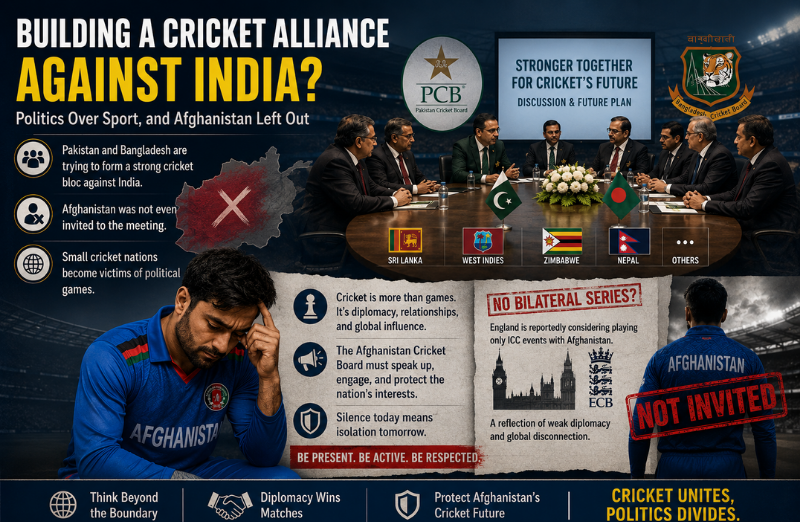
Reports of a new regional cricket bloc led by Pakistan and Bangladesh spark concerns over Afghanistan’s exclusion and its diplomatic standing in global cricket.
By Sayer Zaland | ASJFNEWS Analysis
In recent developments, reports suggest that the Pakistan Cricket Board and the Bangladesh Cricket Board are working toward forming a stronger cricket bloc against India within the global cricket structure.
As part of this initiative, officials from several cricket boards, including Pakistan, were reportedly invited to a consultative meeting hosted in Bangladesh to discuss the proposed plan and future cooperation.
However, what has raised concern is not only the exclusion of India, given its status as a regional rival, but also the absence of Afghanistan from the meeting. This development is being viewed by some as a concerning signal for Afghanistan’s position in emerging cricket dynamics.
While India remains a financially and structurally dominant cricket nation, analysts believe such blocs may have a limited impact on it. However, Afghanistan could be directly affected by shifting alliances and decisions within international cricket structures.
Critics argue that the objective behind such initiatives is not the overall development of cricket, but rather the pursuit of strategic and political interests, with smaller cricket boards potentially being used as instruments in larger geopolitical and sporting rivalries.
At the same time, concerns are being raised over the silence of the Afghanistan Cricket Board, which has not issued any formal response to these developments. Observers say the board has remained largely inactive in international cricket diplomacy and engagement.
According to analysts, Afghanistan’s cricket administration appears to have a limited understanding of modern cricket diplomacy, often focusing primarily on organizing domestic tournaments rather than engaging in broader international negotiations and relationships.
In today’s global cricket environment, diplomatic engagement and strategic relationships are increasingly seen as crucial as on-field performance. Experts suggest that Afghanistan requires a stronger and more experienced diplomatic capacity to safeguard its interests in an evolving cricket landscape.
Meanwhile, renewed reports from England suggest that the England and Wales Cricket Board may restrict bilateral series with Afghanistan, limiting engagements to ICC events only.
If confirmed, such a move would reflect broader challenges faced by Afghanistan’s cricket administration in building and maintaining international relationships and effectively communicating its position to global cricket bodies.
Critics further argue that restricting Afghanistan’s bilateral participation could be seen as discriminatory, particularly when viewed against global discussions around equality in sport. However, these arguments are reportedly not being effectively communicated by Afghan cricket officials to international stakeholders.
At the domestic level, concerns are also being raised over inconsistent treatment of players and a lack of communication. While Afghan stars such as Rashid Khan, Noor Ahmad, and Allah Mohammad Ghazanfar continue to feature in major leagues like the IPL, questions are simultaneously being raised over their participation in local camps.
Observers note that such contradictions, combined with administrative silence, continue to fuel concerns over governance, communication, and strategic direction within Afghan cricket.