
Beyond the Scoreboard · 20 October 2026
Seven Wins Were Not Enough. What Did UFC Want From Farid Basharat?
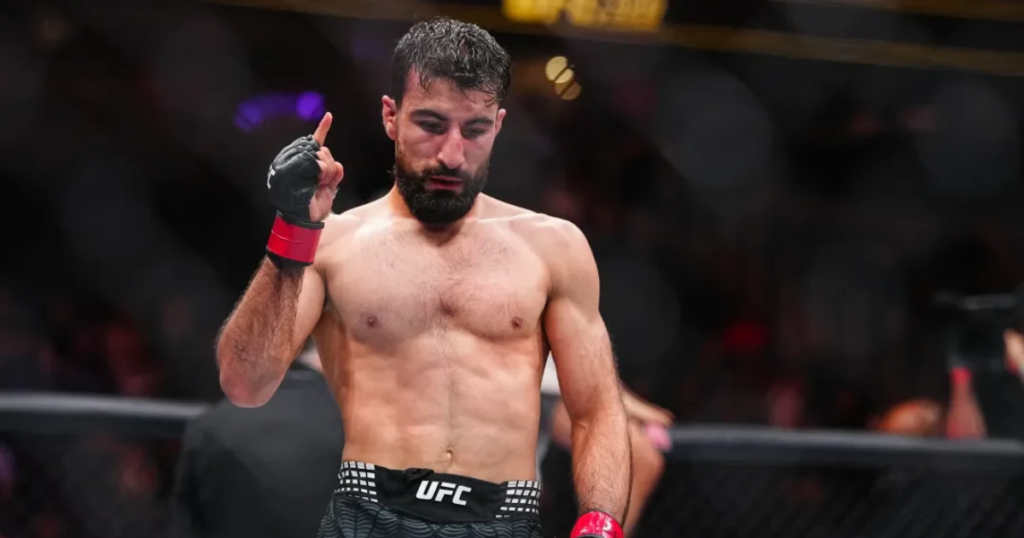
Farid Basharat says UFC officials criticised his fighting style before his contract went unrenewed. His account offers the clearest public clue to the split, but the promotion has not explained what ultimately determined its decision.
BY SAYER ZALAND
In July, before his last UFC appearance, Farid Basharat spoke about a concern that an unbeaten contender might reasonably expect to have settled. He wanted a new contract.
His existing agreement had one fight remaining. He told MMA Fighting that he would have preferred to renew immediately, but was going ahead without an extension. Another strong performance, he hoped, would secure his future.
He defeated John Garza. The new deal did not come.
By October, Basharat was out of the promotion with a 16–0 professional record, including seven UFC victories. He had fulfilled his competitive assignment and still lost his place. What, then, had the UFC been asking him to prove?
His recent account points towards dissatisfaction with how he fought.
According to reporting on his interview with Demetrious Johnson, Basharat said UFC officials had told his manager they disliked his style after his victory over Chris Gutierrez. He said similar feedback followed his win over Jean Matsumoto.
That is more specific than the speculation which initially surrounded his departure. Basharat is describing criticism he says reached his camp before the contract decision. If accurate, it suggests that winning and satisfying the promotion had become separate tasks.
There is an important qualification: the underlying exchanges have not been published, and the UFC has not confirmed them. Basharat’s account supports the argument that style mattered. It does not establish whether style was the sole reason, one consideration among several, or the decisive factor.
Dana White’s public response did little to resolve that uncertainty. Asked about Basharat after UFC Edmonton, he discussed fighters who are difficult to work with and those who reject bouts. He did not identify a specific incident or an opponent Basharat had refused.
Those omissions matter. A general observation from the chief executive can quickly become a specific allegation in the retelling. Saying that some fighters lose contracts because they refuse fights is not evidence that Basharat did so.
Basharat denies turning down opponents or causing problems for UFC staff. His response deserves to stand alongside White’s remarks. Neither side’s public statements, however, provide a complete record of their dealings.
The strongest available explanation therefore remains narrower than many of the arguments online: Basharat says the organisation had expressed dissatisfaction with his performances, despite continuing to put wins beside his name.
Six of his seven UFC victories came by decision. That helps explain the attention given to his style, but it is an inadequate verdict on the quality of his fights. A decision tells us that neither athlete secured a stoppage. It tells us little about the pace, the exchanges or the difficulty of overcoming the opponent.
Viewers are entitled to find a successful fighter unexciting. Others are equally entitled to enjoy controlled, technically accomplished performances. The accessible online discussions contain both views. They establish disagreement about his appeal, not knowledge of why his contract ended.
The UFC also has commercial interests to consider. An unbeaten record does not oblige it to offer another agreement. But the decision raises a fair sporting question: how clearly can a fighter understand the route to advancement when repeated victories do not secure continued employment?
The uncertainty affects preparation as well as ambition. A competitor may be left wondering whether to abandon an effective approach, accept greater risks or devote more attention to publicity. Without a clear explanation, he cannot know which change—if any—would address the promotion’s concerns.
For Afghan supporters, Basharat’s departure is understandably difficult to accept. Yet the case for scrutiny is strongest when it stays with what can be demonstrated. His record warrants serious questions. His nationality does not establish a motive for the decision, and loyalty to him does not require accepting every theory offered in his defence.
There are straightforward ways to advance the story. Basharat and his manager could substantiate the feedback they describe. The UFC could say whether entertainment value determined the non-renewal. If rejected opponents or professional conduct were relevant, it could identify the circumstances and allow him to answer.
Until then, the exact cause remains unconfirmed. The evidence makes dissatisfaction with his style a credible explanation, based on his account; it does not turn that explanation into an established finding.
Basharat went into his final contracted appearance believing another victory would strengthen his case. He won and waited. The UFC has explained neither what was missing nor why it chose to move on.