
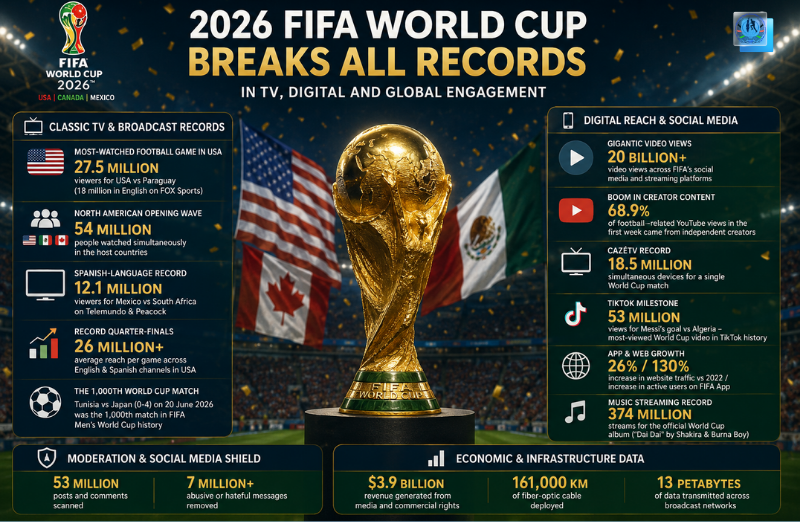
The 2026 FIFA World Cup in the United States, Canada and Mexico set unprecedented records across television, digital platforms and social media, reflecting the tournament’s expanded 48-team, 104-match format. FIFA also reported significant growth in online engagement, broadcasting reach and digital infrastructure throughout the competition.
Kabul | By Sara Amiri
The 2026 FIFA World Cup established new benchmarks for global media consumption, television audiences and digital engagement, with FIFA reporting record-breaking figures across multiple platforms during the expanded tournament.
Featuring 48 teams and 104 matches for the first time in World Cup history, the tournament attracted unprecedented audiences worldwide, benefiting from favorable kick-off times for viewers across the Americas.
Television and Broadcast Records
The United States’ opening match against Paraguay became the most-watched men’s football match ever broadcast in the United States, drawing a combined audience of 27.5 million viewers, including 18 million English-language viewers on FOX Sports.
Across the three host nations—the United States, Mexico and Canada—an estimated 54 million people watched their respective national teams simultaneously on the tournament’s opening matchday.
The opening match between Mexico and South Africa also set a new benchmark for Spanish-language broadcasts, averaging 12.1 million viewers across Telemundo and Peacock, making it the most-watched Spanish-language World Cup opening match on record.
The tournament’s four quarter-finals each attracted a combined audience of more than 26 million viewers across English and Spanish-language broadcasters in the United States.
On 20 June 2026, another milestone was reached when the match between Tunisia and Japan became the 1,000th match in FIFA Men’s World Cup history.
Record Digital Engagement
FIFA reported more than 20 billion video views across its social media and streaming platforms before the tournament concluded.
Independent digital creators played a growing role in football coverage. During the tournament’s opening week, 68.9% of football-related YouTube views came from independent content creators rather than traditional broadcasters.
Brazilian streaming channel CazéTV recorded 18.5 million simultaneous devices during a single World Cup match, highlighting the growing influence of digital-first sports broadcasting.
A video of Lionel Messi’s goal against Algeria became the most-viewed World Cup clip in TikTok history, receiving 53 million views.
Traffic to FIFA’s official website increased by 26% compared with the 2022 World Cup, while the FIFA App recorded a 130% increase in active users.
The tournament’s official song, “Dai Dai” by Shakira and Burna Boy, also enjoyed significant commercial success, helping the official World Cup album surpass 374 million streams.
Online Safety and Content Moderation
FIFA said its digital protection systems monitored approximately 53 million social media posts and comments during the tournament.
More than 7 million abusive or hateful messages were removed as part of the organization’s online moderation efforts designed to protect players, officials and fans.
Commercial and Infrastructure Milestones
FIFA reported generating approximately US$3.9 billion in revenue from media and commercial rights during the 2026 World Cup year.
To support worldwide Ultra High Definition (UHD) broadcasting of all 104 matches, broadcast partners relied on approximately 161,000 kilometers of fiber-optic cable, while more than 13 petabytes of data were transmitted across global broadcast networks.
The 2026 FIFA World Cup, jointly hosted by the United States, Canada and Mexico, was the first edition of the tournament to feature 48 national teams and 104 matches. The expanded format contributed to record-breaking global audiences, increased digital engagement and significant commercial growth, making it one of the largest sporting events in history.