
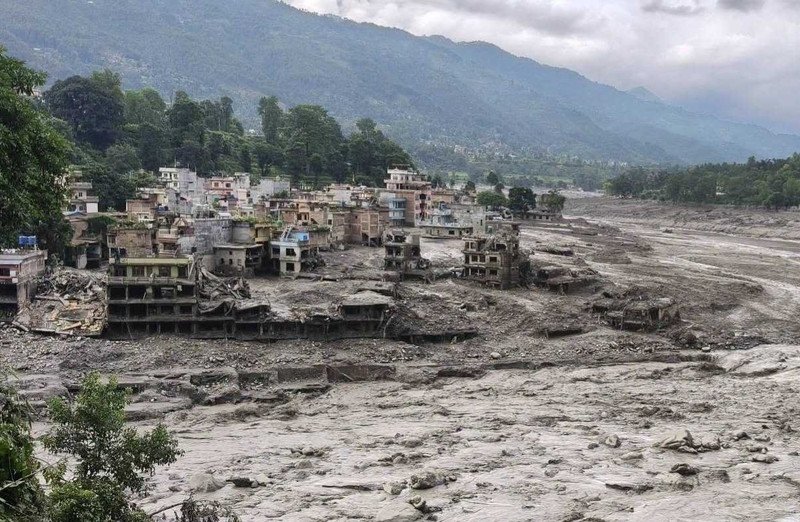
Nepalese sports journalist Niranjan Rajbanshi says a destructive flood swept away his birthplace, Trishuli Bazar, devastating communities across the Rasuwa-Nuwakot region.
His account describes the loss of relatives, homes, bridges and hydropower infrastructure, as well as messages of solidarity from the international sports community.
KATHMANDU | By ASJFNEWS STAFF
Nepalese sports journalist Niranjan Rajbanshi says the flood that struck the Rasuwa-Nuwakot region erased much of Trishuli Bazar. In this riverside town, he was born and raised, leaving family members and neighbors dead or missing.
Writing from Kathmandu on Aug. 29, Rajbanshi described watching footage of a bridge near his former home being swept away as reports emerged of destruction across dozens of villages. He said the flood damaged more than 20 concrete bridges, numerous suspension bridges and over a dozen hydropower plants.
Rajbanshi said the damage accounted for about 10% of Nepal’s hydroelectric capacity and cost the country billions of rupees. Those figures were presented in his personal account and were not independently verified by ASJFNews.
The disaster became deeply personal when Rajbanshi learned that two sisters-in-law and a young nephew were among those swept away. A cousin told him that 64 people from communities around the family home, including neighbors, friends and relatives, had been carried away, while others remained missing.
“It wasn’t just a river,” the cousin told him. “It was an entire ocean surging forward.”
Rajbanshi said residents had received warnings before the flood. Lelin Ranjit, a local ward chairperson, told him that police used loudspeakers to urge people to leave, but many did not believe the river could rise to such a destructive level.
The Trishuli River, which runs through rugged mountain terrain from near the Tibetan border, had previously been affected by landslides and seasonal flooding. Rajbanshi recalled moving to safer ground after warnings during his childhood, but said no earlier flood had approached the scale of this disaster.
His family home stood about 100 meters from the river. His school, a nearby temple, the football ground where he played and much of the historic market were among the places he said had disappeared or been transformed into riverbed.
Rajbanshi built his career in sports journalism after leaving Trishuli Bazar for university studies in Kathmandu. Because the town is about 50 kilometers from the capital, he continued to return for festivals, prayers and visits with childhood friends.
The account also highlighted the role of sport in responding to tragedy. Rajbanshi said a moment of silence observed by players from Spanish club Barcelona for Nepal’s flood victims moved him, while condolence messages from members of AIPS and AIPS Asia offered comfort during the crisis.
He said the solidarity provided hope as rescue, relief and reconstruction efforts continued, and argued that the disaster should be understood as part of a wider human challenge linked to increasingly destructive natural hazards and climate change.
Trishuli Bazar is a historic town in Nepal’s Nuwakot district. According to Rajbanshi’s account, it was once an important trading center on the route to Tibet and served as a commercial hub for surrounding communities.
This report is based on Rajbanshi’s firsthand account published by AIPS Media. Casualty and infrastructure figures remain attributed to the people and sources cited in that account.
Photo: AIPS Media / Niranjan Rajbanshi. Image reuse permission should be confirmed before publication.