
Beyond the Scoreboard · 13 October 2026
Atal Built the Resistance. Afghanistan’s Tail Finished the Job
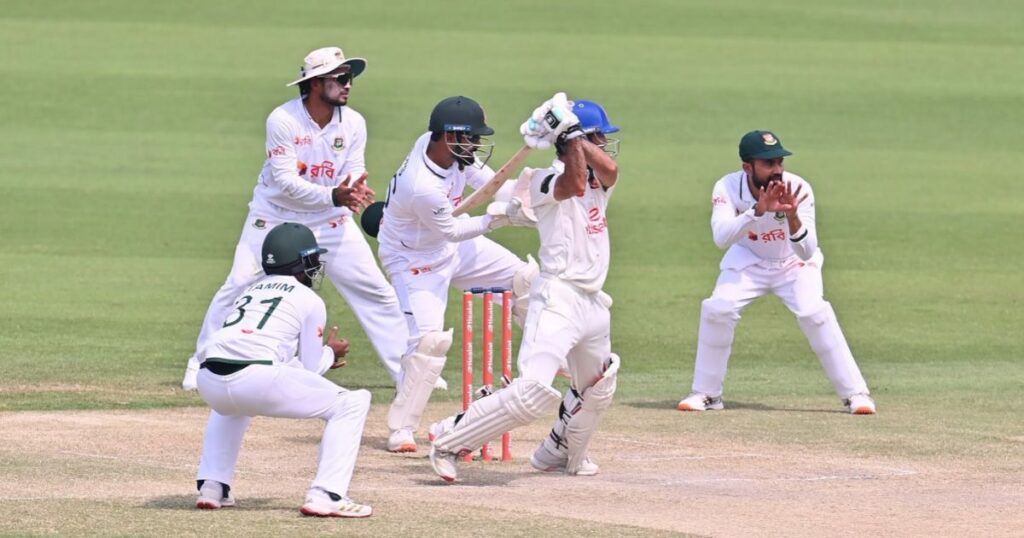
Afghanistan began the final day with seven wickets standing and finished it with two still intact. Sediqullah Atal’s century gave them a chance to save the Test, before the lower order denied Bangladesh the finish they needed.
ASJF NEWS Editorial Board
Qais Ahmad hit the last ball for six. By then, Afghanistan had already secured the draw. The stroke provided a memorable ending, but the result had been earned through the less spectacular work that preceded it: deliveries survived, partnerships extended and wickets made difficult to take.
Afghanistan’s final-day achievement in Abu Dhabi deserves to be understood that way. The late resistance was essential. So was the patient batting that ensured the lower order had a match left to save.
They began on 132 for three, still 347 runs short of the target of 479. Atal resumed on 35 alongside Hashmatullah Shahidi on 19. Bangladesh needed seven wickets; Afghanistan needed to keep batting until the opportunity to take them had passed.
The morning brought an early disruption when Shahidi retired hurt. Ikram Alikhil joined Atal, and their 66-run partnership prevented that interruption from becoming a collapse. Ikram’s dismissal for 33 shortly before lunch left Afghanistan at 203 for four. Bangladesh had a breakthrough, but the session had cost them time.
That was the first important feature of Afghanistan’s approach. A change at the crease did not immediately undo the work already completed. The next batter helped continue it.
Atal remained the constant. His 111 from 332 balls gave the innings its structure. The significance of that century lay in how long he remained available to his partners. While he was there, each incoming batter could join an established innings rather than start the resistance again alone.
Afghanistan reached tea at 265 for six, with Atal still unbeaten. Ismat Alam had made only four, but used 60 deliveries. Shahidi returned and finished with 36. Their contributions differed in size, yet both helped consume the time Bangladesh required to force a result.
Then Atal fell at 281 for seven.
His dismissal changed the final session. Bangladesh had removed the batter around whom Afghanistan’s innings had been built. Three wickets remained, and the bowlers had an opening against the tail.
Yamin Ahmadzai and Qais refused to make that opening decisive. Their eighth-wicket partnership added 45 runs and lasted 110 deliveries. Those deliveries were the central achievement of the stand: Bangladesh could take encouragement from Atal’s dismissal, but could not turn it into a rapid finish.
Yamin’s 19 from 85 balls was a substantial contribution to this particular task. For a lower-order batter, remaining at the crease for that long demands more than determination. It requires enough judgment and control to withstand repeated attempts to expose a weakness.
Qais supplied a different innings, finishing unbeaten on 49 from 80 balls. His runs mattered, but so did his presence after Yamin was dismissed. Zia-ur-Rehman then faced 12 balls without scoring. In the circumstances, zero was a useful contribution: Bangladesh needed his wicket, and did not get it. Afghanistan closed on 346 for eight after 142 overs.
Bangladesh also missed opportunities. A dropped catch and missed run-out chances formed part of the escape. An honest assessment must acknowledge them. Afghanistan’s resistance was not flawless; it was persistent enough to make those errors costly.
The lesson for Afghan cricket is practical. Lower-order batting deserves preparation because it can determine a Test result. A bowler who can survive another spell or support a recognised batter gives the team an additional chance. That work should carry weight in training and selection.
This draw does not remove the concerns created by Afghanistan’s first-innings deficit. It does, however, establish something worth building on: when their leading resistance ended, the remaining batters continued the task.
Atal made Bangladesh work through most of the innings. Yamin, Qais and Zia made them keep working to the end. Afghanistan saved the Test because responsibility passed down the order—and the final batters accepted it.