
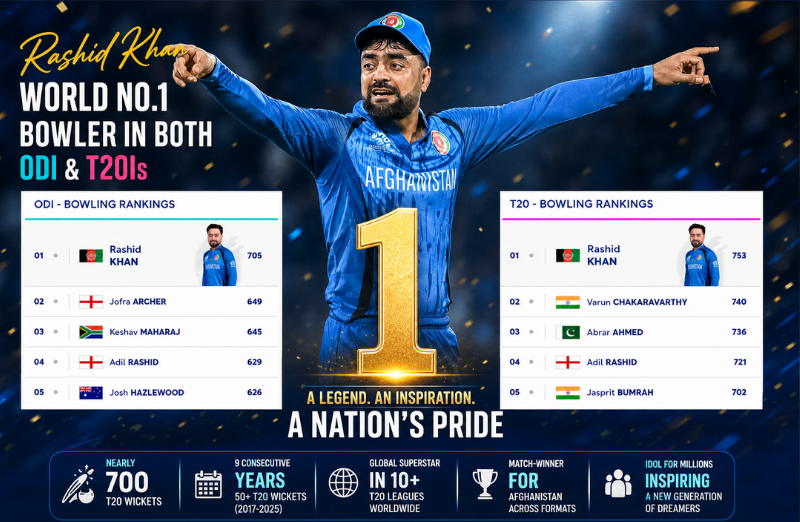
At a time when Afghanistan continues to confront political uncertainty, economic hardship, and social fragmentation, Rashid Khan has emerged as one of the country’s most powerful global symbols, transcending sport to become a figure of national pride and international admiration.
The Afghan leg-spinner is now ranked the No.1 bowler in the world in both One Day Internationals (ODIs) and Twenty20 Internationals (T20Is), according to the latest ICC rankings, further cementing his status as one of the defining cricketers of his generation.
For many cricket observers, Rashid’s rise is no longer simply a sporting success story. It has become a narrative about resilience, identity, and the global reach of Afghan talent despite decades of instability.
Born in Nangarhar province and raised during years shaped by conflict and displacement, Rashid developed his cricket in modest conditions far removed from the elite academies and infrastructure available to many of his international rivals. Yet through relentless discipline and rare technical skill, he transformed himself into one of the most feared cricketers in modern cricket.
His influence now stretches far beyond Afghanistan’s national team. Rashid has become a global cricket icon through participation in major franchise leagues around the world, including the Indian Premier League, Australia’s Big Bash League, The Hundred in England, Major League Cricket in the United States, and other international competitions. His presence has helped place Afghan cricket at the center of the sport’s modern commercial era.
Statistics underline the scale of his dominance. Rashid has taken nearly 700 wickets in T20 cricket, more than one thousand wickets in all formats, and remains among the most successful bowlers in the history of the T20 format. Analysts frequently describe him as one of the greatest T20 bowlers the game has produced.
His career, however, is defined not only by numbers but by consistency. Between 2017 and 2026, Rashid claimed nearly 100 wickets in T20 cricket every year, an achievement unmatched by any other bowler in the format.
Equally significant is the symbolic role he now occupies for Afghan youth. In a country where opportunities for young people often remain limited, Rashid represents the possibility of international success through dedication and self-belief. Young cricketers across Afghanistan increasingly model their bowling actions, celebrations, and ambitions on him, while his popularity extends across South Asia and the wider cricket world.
His journey has also become a lesson in perseverance. Reports have revealed that Rashid was once rejected during Afghanistan’s under-19 selection trials before eventually becoming the country’s greatest cricket star. That transformation from overlooked teenager to global superstar has only strengthened his inspirational image among younger generations.
Beyond the field, Rashid has frequently used his platform to advocate for Afghanistan and support humanitarian causes, reinforcing his reputation as more than just an athlete. For many Afghans living both inside and outside the country, he has become a rare unifying figure in an increasingly divided national landscape.
Cricket experts believe Rashid’s success has fundamentally changed perceptions of Afghan cricket worldwide. Afghanistan is no longer viewed merely as an emerging team but as a nation capable of producing world-class players who can dominate at the highest level of international sport.