
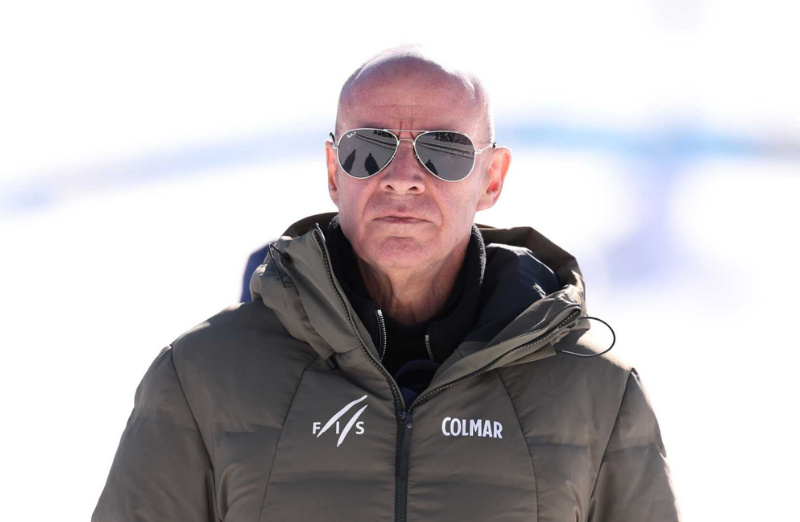
FIS President Johan Eliasch attends the medal ceremony in the Men’s 10km Interval Start Free at the Milano Cortina 2026 Games at Tesero Cross-Country Skiing Stadium on February 13, 2026 in Val di Fiemme, Italy. (Photo by Lars Baron/Getty Images)
The case of Johan Eliasch, FIS president, who, in order to run for re-election in June, was forced to become a Georgian citizen in a flash, despite already holding a Swedish and British passport, is at the very least curious, if not anomalous.
“Nomadic” President Eliasch can be considered the first “nomadic” president, changing countries if necessity dictates. From a sporting ethical perspective, this is certainly not the best…
In this case, he was forced to do so by the fact that the two federations to which he was affiliated preferred to propose other names for the Executive Committee of the International Ski Federation. A millionaire and fortune-maker, he’s not popular with the sports leaders at home, nor with some others. During his four years in office, he failed to convince them, despite his track record as a high-level industrial executive having initially opened all doors for him.
The Messiah They thought of a new messiah, arriving just in time to find suitable solutions, including to combat the cursed climate change. Eliasch took Head, the ski manufacturer, to the top of the world. To avoid a conflict of interest, he said he had distanced himself, but truth be told, his jacket seems still tangled in the industrial fabric. And Head won the manufacturers’ championship again this year, but by a wide margin.
FIS Switzerland Until five years ago, the FIS was Swiss. Marc Hodler was the legendary president of the golden years of skiing’s revival. He was the head of an orderly and appreciative world ski club. At the end of the millennium, he stumbled in the voting scandal for the 2002 Salt Lake City Winter Olympics. He was then succeeded by Gianfranco Kasper, former general secretary and a skilled weaver of alliances, who kept the lively Austrian competition at bay. The federation was described as “family-run,” suited to the skiing world, which loves to live on memories during long winter nights at the bar.
Journalists Out Eliasch was supposed to bring a breath of fresh air, but as far as we journalists are concerned, he’s practically sidelined us, like an old toy. He canceled post-race press conferences at World Cup races, saying that athletes are tired, have to travel, and then, thank goodness, they’re already in the mixed zone. His respect for independent and accurate information is practically nonexistent.
Hyperego He has a very developed ego, so much so that as soon as he joined the IOC as an ex officio member, as FIS President, he even ran for the IOC presidency, garnering two votes. Of course, in sport, winning isn’t important, but participating is, but we believe this move, which we would call risky and disrespectful, hasn’t done him any good in the world of skiing either.
Small Nations Now some are complaining that Eliasch might have many small nations on his side, always hungry for help to survive, but he didn’t create them: they are the offspring of ancient maneuvers, which also served to demonstrate that skiing has a large global catchment area. And they also had great electoral weight.
Reform We believe that perhaps this “identity crisis” could be useful for initiating a structural and cultural reform, which is more necessary than ever. To achieve this, candidates with concrete visions and those aligned with the reality of the sport are needed, if not FIS could go down the wrong path.
A Memory In the 1970s and 1980s, I arrived in the world of skiing and found an environment in turmoil, because there were those who wanted to professionalize the athletes and said that the future would be a circuit of ski brand teams, like in Formula 1. The companies wanted to lead and said they were tired of subsidizing the various pools of national federations. Fortunately, sporting rationality prevailed, because skiing’s fortune lies in the fact that the World Cup is attended by national teams, those with the flag.
The risk: If the new role of a nomadic president is accepted, the FIS risks sliding down a dangerous slope of deregulation, potentially leading to statutory chaos. Eliasch is an experienced man who knows how to manage complicated situations, but this time the image of an international federation practically up for sale to the highest bidder, not awarded on sporting merit, isn’t helping his ambitious plans either. For him, the time has come for deep reflection.