The Times Apologises to FIFA and Infantino Over Salary and Property Claims
British newspaper The Times has withdrawn claims that FIFA president Gianni Infantino received an undisclosed second salary and acquired a Miami property at a suspected undervalue. The correction raises questions about the verification of allegations against powerful sports officials without diminishing the importance of independent scrutiny.
21 October 2026
ZURICH, SWITZERLAND | BY SAYER ZALAND
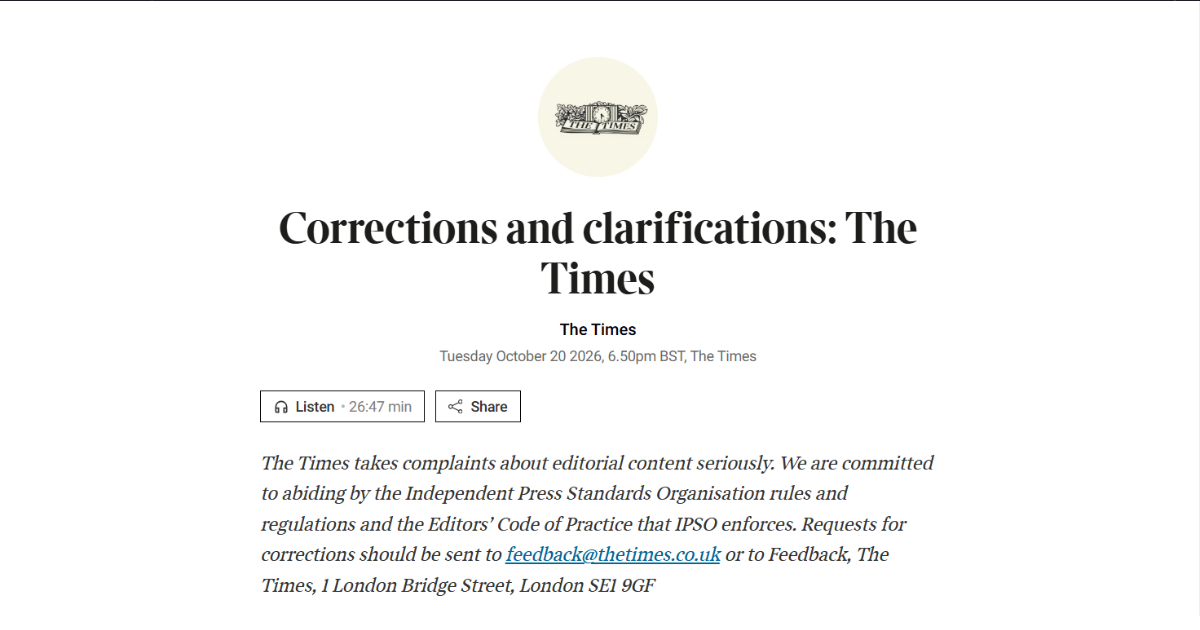
British newspaper The Times has apologised to FIFA and its president Gianni Infantino after acknowledging errors in a report that alleged undisclosed payments and questionable property dealings involving the head of world football.
The correction concerns claims published on October 13, including an allegation that Infantino received a second salary from FIFA which the organisation had not disclosed.
The newspaper has now withdrawn that claim.
According to the correction reproduced by FIFA on Wednesday, there was no second salary. The newspaper also acknowledged that expenses and reimbursements received by Infantino are not classified as compensation under the Swiss reporting requirements governing FIFA’s annual disclosures.
That distinction is central to the case.
Expenses and reimbursements are not necessarily equivalent to salary, and the reporting requirements applicable to each category can differ.
The original allegation suggested that FIFA had failed to disclose a form of remuneration. The correction accepts that the payments in question did not constitute the alleged second salary and were not required to be reported as compensation under the relevant rules.
The Times also corrected its reporting about a property in Miami.
The newspaper acknowledged that Infantino had not purchased the property at a suspected undervalue, contrary to its earlier report.
It further accepted that neither Infantino nor members of his family were the legal or beneficial owners of Shadi LLC, a company linked to the property in the original coverage.
The newspaper also withdrew its suggestion that Infantino or his family controlled the company.
The correction therefore addresses two separate sets of claims: the characterisation of payments received by the FIFA president and allegations concerning ownership or control of a property-related company.
The newspaper apologised to Infantino and FIFA for the errors.
FIFA welcomed the correction and said the episode demonstrated the need for journalists to verify information carefully before publishing allegations that could damage reputations.
The governing body also reiterated its position that some of the criticism directed at FIFA and its president formed part of an effort to undermine them.
That allegation is FIFA’s assessment; the newspaper’s correction does not independently establish the existence of a coordinated campaign.
FIFA said it welcomed legitimate scrutiny while maintaining that inaccurate or defamatory allegations should be challenged.
The dispute comes at a sensitive moment for football governance.
Infantino’s leadership is facing separate questions over FIFA’s commercial decision-making, including a proposed investment structure involving the organisation’s commercial rights.
Those broader governance questions remain distinct from the salary and property claims withdrawn by The Times.
The correction does not establish that all reporting about FIFA’s administration or the president’s conduct is inaccurate.
Nor does the existence of legitimate questions about football governance justify repeating claims that the original publisher has formally corrected.
For sports journalism, the episode demonstrates why evidence, financial terminology and ownership records require particular care when allegations concern public figures and influential institutions.
Investigative reporting depends on the freedom to examine those in power. Its credibility also depends on correcting the public record when important factual claims cannot be sustained.
In this case, The Times has acknowledged errors on specific matters and FIFA has received an apology.
The wider responsibility of independent sports journalism remains unchanged: scrutinise institutions rigorously, distinguish established facts from allegations and correct inaccuracies openly.
Sources: FIFA official statement, 21 October 2026; The Times correction reproduced by FIFA; Reuters reporting on the wider FIFA governance dispute.
Image caption: FIFA president Gianni Infantino. British newspaper The Times apologised after correcting claims concerning his remuneration and a Miami property.
Image credit: Original photographer or image agency to be confirmed. A FIFA-supplied image should be credited to its actual rights holder.